
Running a Check in Nevada
The Nevada Public Sex Offender Registry is the state's official public compilation. The Central Repository for Nevada Records of Criminal History maintains it within the Nevada State Police Records Bureau. The public list is a notice system based on convictions and state law. It is not a finding that each listed person poses a current threat. Nevada also warns that a name result cannot provide fingerprint-level identification. Compare the photograph, aliases, physical traits, address, vehicle, and offense details before drawing a conclusion.
Public coverage has limits. It includes all Tier II and Tier III registrants, Tier I registrants whose qualifying offense involved a child, and specified juvenile registrants. Adult-victim Tier I information is withheld. A blank Nevada sex offender check can therefore mean no public match, different search data, or a record outside the public tier rules. It does not prove that no registration record exists.
The official conditions-of-use screen shows the required gate before a search.
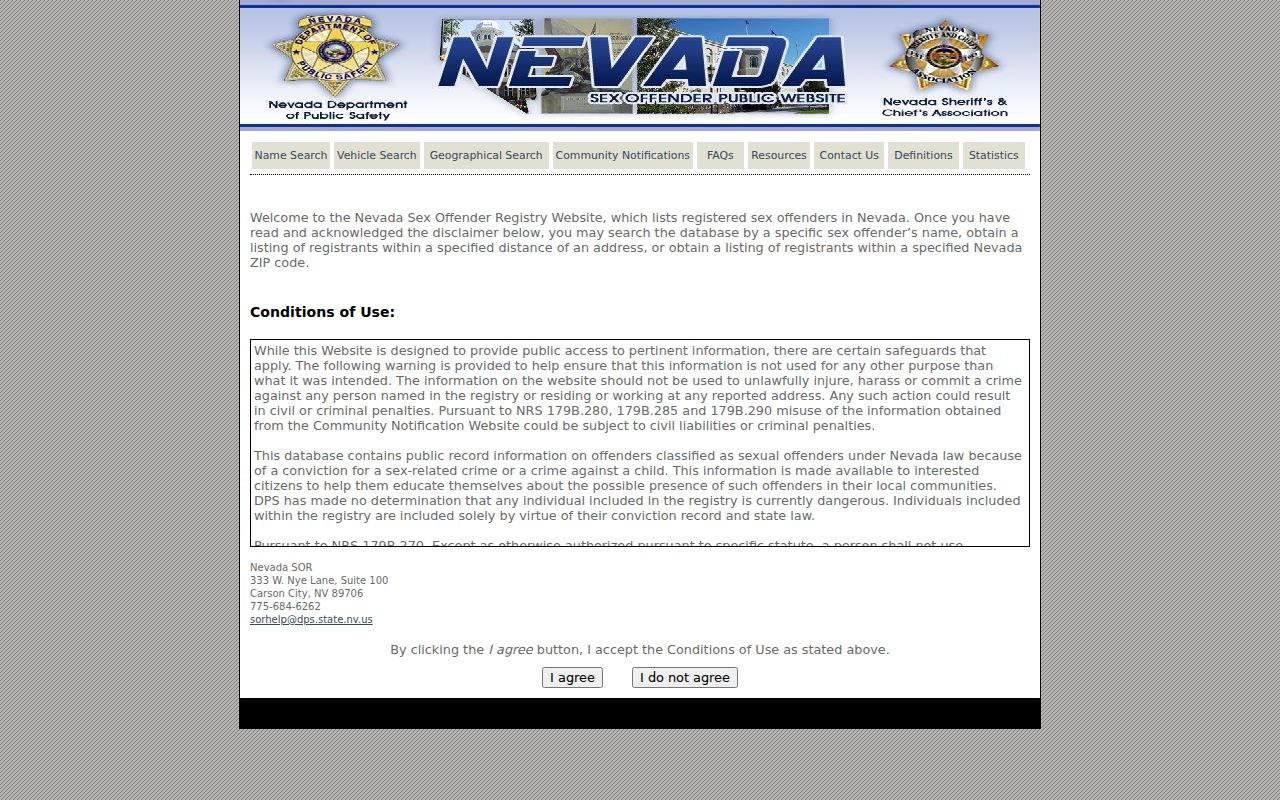
That acknowledgment puts accuracy, identity, and lawful-use limits in front of every Nevada registry user.
Nevada Registry Tier I Search Gaps
Nevada's public website is not the full registration file. NRS Chapter 179B makes the community-notification website the public source of record, yet NRS 179B.250 restricts which people and fields appear. Tier I records tied to an adult victim are not public. Victim identities, Social Security numbers, full birth dates, nonconviction arrests, and the names of work or school locations also stay off the public profile.
The distinction matters when a known court case does not produce a public Nevada registry result. The court file may show a conviction while the public tier rule withholds the person. A miss can also come from an alias, spelling, address, or update issue. Retry with sound variants. Then confirm a safety-critical question with the responsible local agency or the originating court. Nevada State Police says registry facts change often and may not always be independently confirmed by the Repository.
Note: A Nevada public search result reflects statutory visibility, not the complete file held by law enforcement.
Searching the Nevada Public Sex Offender Registry / Community Notification Website
The Nevada portal offers name, vehicle, and geographical modes after a CAPTCHA and conditions-of-use gate. Search is free. Begin with the narrowest facts you know, then broaden carefully. Exact wildcard behavior is not stated at the public gate, so avoid assuming that one spelling captures every alias. The community-notification feature provides a separate route for requested updates.
- Open the official Nevada registry, solve the CAPTCHA, read the conditions, and choose “I agree.”
- Select Name Search, Vehicle Search, or Geographical Search. Enter only facts that fit that mode.
- Open a possible profile. Compare the photo, aliases, physical description, reported address, vehicle, tier, and offense.
- For changes, use Community Notifications. Confirm urgent or stale data with the responsible local law-enforcement office.
| Field Label | Type | Required | Notes |
|---|---|---|---|
| CAPTCHA Code | Text plus image/audio | Yes | Required before portal entry |
| Last and First Name | Text | Search-dependent | Aliases may help; matching rules are not stated |
| Vehicle Search | Tab and identifying input | Search-dependent | Supports plate or vehicle details; exact post-gate controls vary |
| Address and ZIP | Text | Geographic mode | Use a full Nevada address or a five-digit ZIP |
| Distance or Radius | Selector | Radius mode | Exact choices are not exposed before the access gate |
| Notification Contact | Signup text | Signup-dependent | Supports requested updates; exact post-gate labels are not public |
The official Nevada registry search form places these modes behind the common access gate.
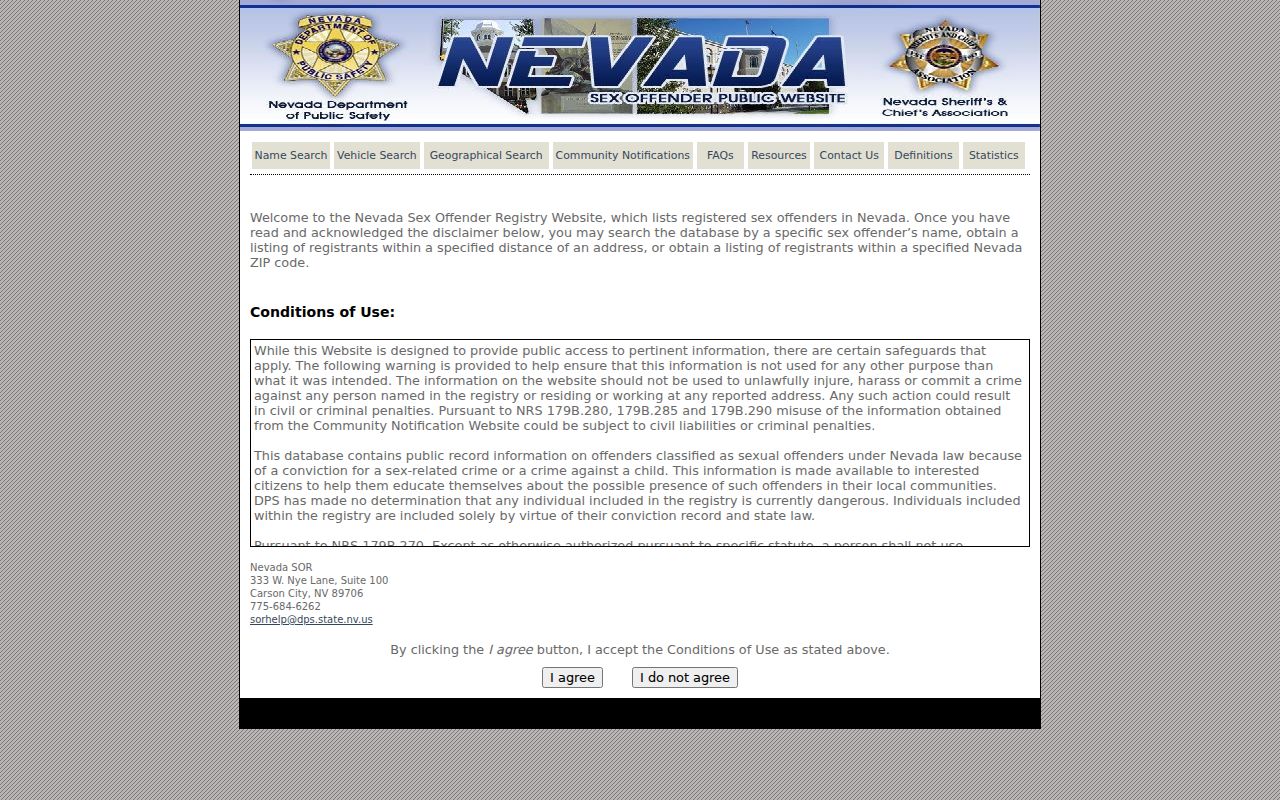
The form supports a statewide check, but each open profile still needs close identity review.
Nevada Registry Vehicle and Radius Searches
A name is not the only useful starting point. Nevada exposes a dedicated vehicle search because public profiles may include a license plate and a description of a vehicle owned, operated, or frequently driven by the registrant.
Vehicle details can distinguish possible matches, but they can change and should never replace photo and profile comparison.
The Nevada geographical search accepts an address for a distance search or a Nevada ZIP code. State law requires the portal to support a ZIP or radius query. The exact radius menu was not exposed before the CAPTCHA gate, so the available distances should be read on the live form rather than guessed.
Map and ZIP results show reported locations within the selected boundary, not a forecast of conduct or a guarantee that each address is current.
What a Profile Shows
A Nevada registry profile joins identity, location, vehicle, classification, and conviction information. Read each field in context. Tier describes the qualifying offense category and registration term. It is not an individual risk score. The residence is a reported address or location, and a person without a fixed residence may instead report a shelter or habitual sleeping place through the local agency.
| Name & Aliases | Current name, registry identifier, and publicly releasable alternate names |
|---|---|
| Photograph & Description | Current photo, year of birth, sex, race, height, weight, hair, eyes, scars, marks, or tattoos when available |
| Registered Address | Complete reported residence or location; work or school address may appear without the institution name |
| Vehicle | Plate and descriptive details for a vehicle owned, operated, or frequently driven |
| Offense Details | Offense, statute, conviction court, conviction name, and place tied to the qualifying offense |
| Tier & Status | Tier I, II, or III and a current compliance or status marker where maintained |
Underlying law-enforcement records contain more. Fingerprints, palm prints, full birth date, Social Security number, phone, email, Internet identifiers, and other sensitive data are not released through the public Nevada profile.
Nevada Registry or National Search
The state portal is the direct source for Nevada data. It offers Nevada's vehicle and geographic modes, state tier information, and local source cues. If the person may have moved across a state line, the U.S. Department of Justice national public website searches participating jurisdictions in one place.
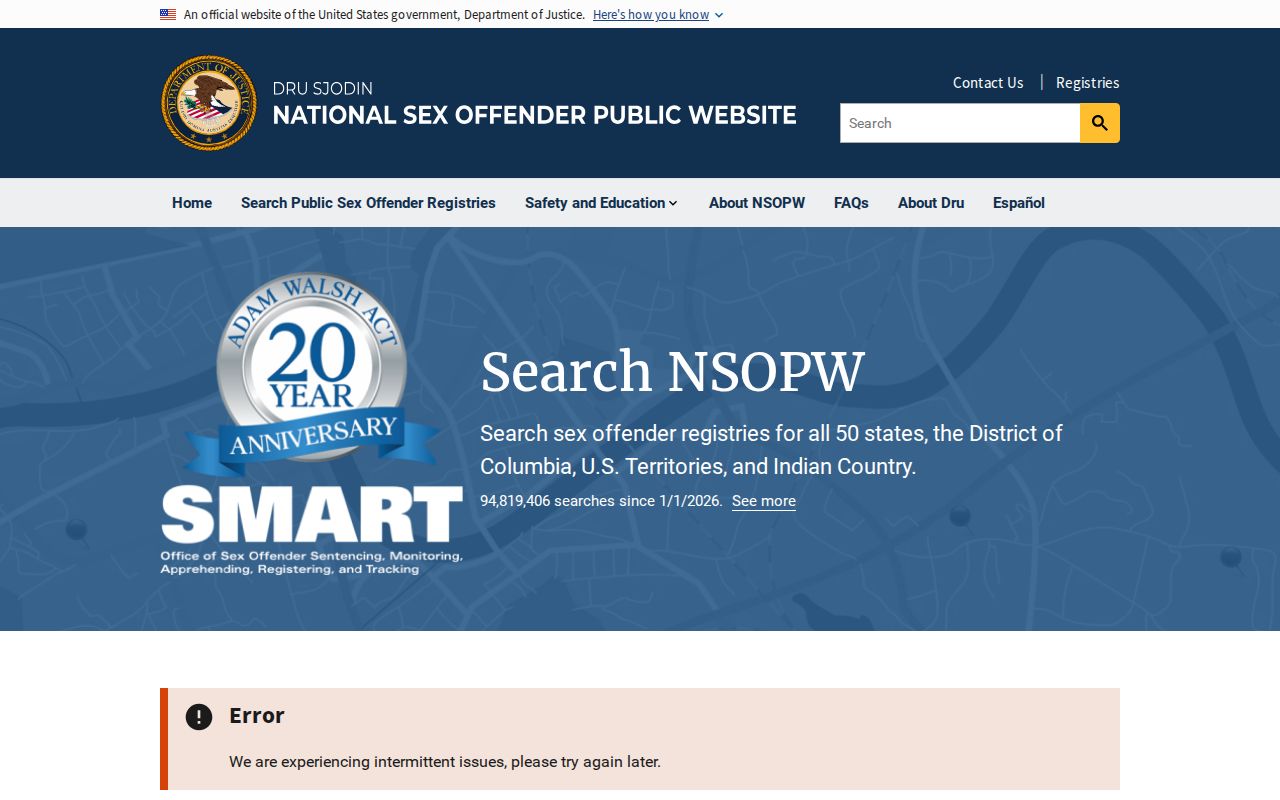
The national layer broadens geographic reach, while Nevada remains responsible for its source record and corrections.
Neither option guarantees a fingerprint match. A national miss also does not override Nevada's public-visibility rules. Use the Nevada profile when the result concerns an address, tier, vehicle, or Nevada conviction detail. Use NSOPW for a cross-border safety question. Then contact the originating jurisdiction if a record seems stale or conflicts with a court file.
Note: Each participating jurisdiction controls its own source data, update schedule, and public disclosure rules.
Registration Requirements and Levels
Nevada uses an offense-based tier system. The categories come from the conviction definitions in NRS Chapter 179D, not a portal judgment about present danger. The tier sets the usual registration duration and the least frequent allowed interval for in-person verification. Time spent incarcerated or confined does not count toward the registration period.
| Nevada Tier | Duration | Verification Frequency |
|---|---|---|
| Tier I | 15 years; a qualifying petition may reduce it by five years after at least ten compliant years | At least annually |
| Tier II | 25 years | At least every 180 days |
| Tier III | Life; a narrow juvenile-adjudication petition may apply after at least 25 compliant years | At least every 90 days |
Initial and update duties operate through local offices. A person not imprisoned must generally register within three business days after sentencing. A person arriving in Nevada faces the local presence and registration rules in NRS 179D.460. Name, residence, work, student, and other status changes carry short in-person reporting deadlines. The local agency sends the new photo, prints, and data to the Central Repository.
Local Offices Feed Nevada Registry Records
The public view is statewide, but registration is local. Depending on place, the operational office is a county sheriff, metropolitan police department, or incorporated-city police department. Officers take the personal appearance, updated information, fingerprints, photograph, signature, and date. They also handle suspected noncompliance and send changes to the Nevada Criminal History Repository.
Use the Nevada county directory when an address looks old, a move is missing, or local verification is needed. Do not confront a listed person. Report suspected failure to register or update to the responsible local law-enforcement agency. NRS 179D.550 treats knowing failure, false information, or another violation as a felony, with higher consequences for a repeat violation within seven years.
Nevada has not published a current statewide registration fee. Registry staff also warn that the state and local offices do not demand money from registrants to resolve noncompliance or warrants. A call that seeks immediate payment should be verified with the Registry or local police.
Nevada Registry Address Rules
Registry status alone does not impose one blanket Nevada distance ban from every school or park. The statewide distance rules identified in current law apply as conditions of lifetime supervision or parole for specified people. Tier III status on lifetime supervision can bring a 500-foot condition around a child-oriented place unless approved. A narrower group with a qualifying offense against a child under 14 can face a 1,000-foot residence condition and active electronic monitoring, subject to statutory exceptions.
Local ordinances and individual release terms may add rules. That makes an address-specific question unsuitable for a broad assumption based on a profile alone. Check the person's actual supervision conditions with the supervising authority and review the local code. The Nevada registry gives the reported location and tier. It does not present every parole, lifetime-supervision, or municipal condition as a single universal field.
Note: A Nevada tier controls registration duties, while a separate supervision order can govern where a particular person may live or go.
Lawful Use
Nevada publishes registry data for public safety and community awareness. State law warns against using it to injure, harass, or commit a crime against a listed person or anyone at a reported address. NRS 179B.280 allows an injured person to seek damages, attorney fees, and costs. It also permits an Attorney General action with a civil penalty of up to $25,000, plus investigation costs and attorney fees.
Criminal consequences can rise with the act. Under NRS 179B.285, using registry information to commit a misdemeanor is punished as a gross misdemeanor. Using it to commit a gross misdemeanor is punished as a category E felony. Nevada may also seek an injunction. Use a result to make safe, lawful choices and to contact law enforcement when facts need review. Never redistribute a profile as a claim of current dangerousness.
Misuse is a crime. Nevada registry data must not be used to harass, threaten, injure, or commit an offense against a registrant or anyone at a reported address.