
Criminal Cases in the Nevada Courts
Nevada divides criminal work among three trial-court levels. Municipal Courts hear city-ordinance misdemeanors and municipal traffic matters. Justice Courts hear misdemeanors and hold the first hearings and preliminary examinations in felony and gross-misdemeanor prosecutions. Nevada District Courts are the general-jurisdiction trial courts. They try felonies and gross misdemeanors after an indictment or bind-over, and they hear appeals from limited-jurisdiction courts.
The Nevada court level shapes the Nevada record trail. A Nevada felony may start with a complaint and initial appearance in Justice Court, then move to District Court for an information, plea, trial, judgment, and sentence. A Nevada city misdemeanor may remain in Municipal Court. Each Nevada clerk keeps the docket and filed documents for that court. Nevada has no public trial-court index that combines all District, Justice, and Municipal Court records. The official Find a Court directory is the statewide starting point, not a statewide case database.
Note: A lower-court case number and a District Court case number may describe different stages of the same Nevada prosecution.
Nevada Criminal Court Jurisdiction
Start with the alleged Nevada offense and where it occurred. Nevada Justice Courts handle misdemeanors, traffic matters, and probable-cause work for more serious Nevada charges. Nevada Municipal Courts deal with city-code misdemeanors and traffic violations inside incorporated cities. Nevada District Courts hold felony and gross-misdemeanor trials. The Nevada Court of Appeals and Supreme Court review appealed matters; they do not serve as trial courts.
| Court | Nevada criminal role | Record source |
|---|---|---|
| Municipal Court | City-ordinance misdemeanors and municipal traffic cases | The city's court site or clerk |
| Justice Court | Misdemeanors plus early felony and gross-misdemeanor proceedings | The township court site or clerk |
| District Court | Felony and gross-misdemeanor trials and lower-court appeals | The judicial district portal or county clerk |
| Appellate courts | Appeals assigned to the Court of Appeals or Supreme Court | Nevada Appellate Case Information System |
This Nevada split prevents a false no-hit. A Nevada Justice Court search will not prove that no District Court filing followed. Likewise, a Nevada District Court portal may not contain a city misdemeanor that stayed in Municipal Court. Nevada criminal case research should follow the charge through each Nevada court that actually handled it.
How to Search Nevada Court Records
Because Nevada has no statewide trial-case search, the right Nevada workflow starts with the court directory and ends with the local clerk. Use the free Nevada Appellate Case Information System only for Nevada Supreme Court and Court of Appeals matters. It cannot confirm that no Nevada District, Justice, or Municipal Court prosecution exists.
- Identify the Nevada county, city or township, and likely court level from the incident location and alleged charge.
- Open that Nevada court through Nevada's Find a Court directory, then try an exact case number before a name.
- For a name search, follow the portal's format and add filing dates, status, or date of birth only as needed to narrow the result.
- Open the Nevada docket and read the latest signed disposition, not just the original charge or an early hearing entry.
- Ask the Nevada clerk for the complaint, judgment, sentence, or certified copy when the portal shows only an index.
The representative District Court form shows why Nevada searches vary by place. The official District Court portal offers the following field pattern, but its coverage is local rather than statewide.
| Field label | Type | Required | Use |
|---|---|---|---|
| Record number or name | Text | One search route | Case number or name in Last, First Middle order |
| Last, first, middle name | Text | Last and first in separate name search | Middle name is optional |
| Case type and status | Selector | No | Narrows criminal case results |
| File date start and end | Date | No | Limits the filing period |
| Booking, state ID, or FBI number | Text | No | Optional cross-reference fields |
Nevada Appellate Records Are Limited
The Nevada appellate portal covers only the Nevada Supreme Court and Court of Appeals. Nevada searchers can use a case number, words from a caption, a participant's last name, an organization name, and optional first or middle names. Closed Nevada cases may need to be included deliberately. A selected Nevada case lists docket entries in filing order, and linked document numbers can open available PDFs. Appendices and confidential or sealed material are not generally online.
The older participant-search screen illustrates the move toward current appellate access. The official legacy appellate page now directs readers toward the newer system.
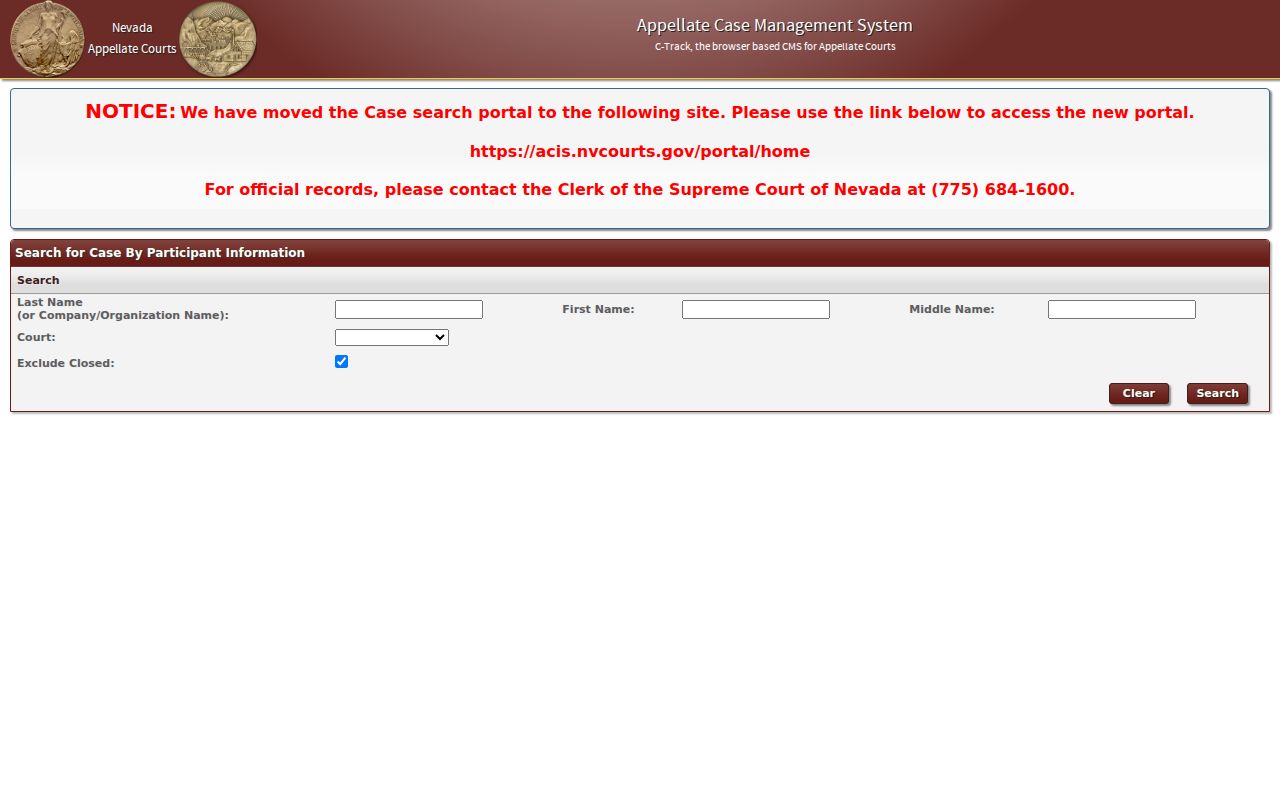
That handoff is useful only after a trial-court judgment has reached the appeal stage. An empty appellate search says nothing about a Nevada trial case that was never appealed.
Note: Appellate docket access does not replace the local trial docket, filed evidence, or signed District Court judgment.
What the Case File Shows
A Nevada criminal case file tracks the court proceeding, not the full statewide identity history. It can show the original complaint, later information or indictment, charge changes, hearings, motions, pleas, verdict, dismissal, and sentence. The register of actions places those events in time. The signed judgment or dismissal order is stronger evidence of the outcome than a search-results row.
| Case Number & Court | Identifies the local court file and the court that processed that stage. |
|---|---|
| Charging Documents | Complaint, information, or indictment stating the filed allegations. |
| Docket Entries | Chronological filings, minutes, orders, and register-of-actions events. |
| Hearing Dates | Scheduled and completed appearances, often with later changes. |
| Disposition | Dismissal, acquittal, plea, verdict, or another formal conclusion. |
| Sentence & Judgment | The signed order stating the final judgment and court-imposed terms. |
The Nevada case file is not a Nevada Repository rap sheet. The Nevada court file holds pleadings and orders for one prosecution. The Nevada Repository compiles reported arrest cycles and dispositions under one fingerprint-linked identity. Nevada reporting delays can make them disagree. If the Repository lacks an outcome, obtain the signed local order before using the subject's official challenge route.
Nevada Trial Portals Differ
Local Nevada portals do not share one set of fields or the same document access. A Nevada District Court system may allow names, dates, status, judicial officer, booking numbers, and other filters. A Nevada Justice Court can run a separate calendar and case channel. Some Nevada results provide only docket data. Public document images may require a Nevada clerk request, an account, or a copy charge.
The manifest captures both sides of that local model. The representative District Court portal shows a broad trial-court search interface.
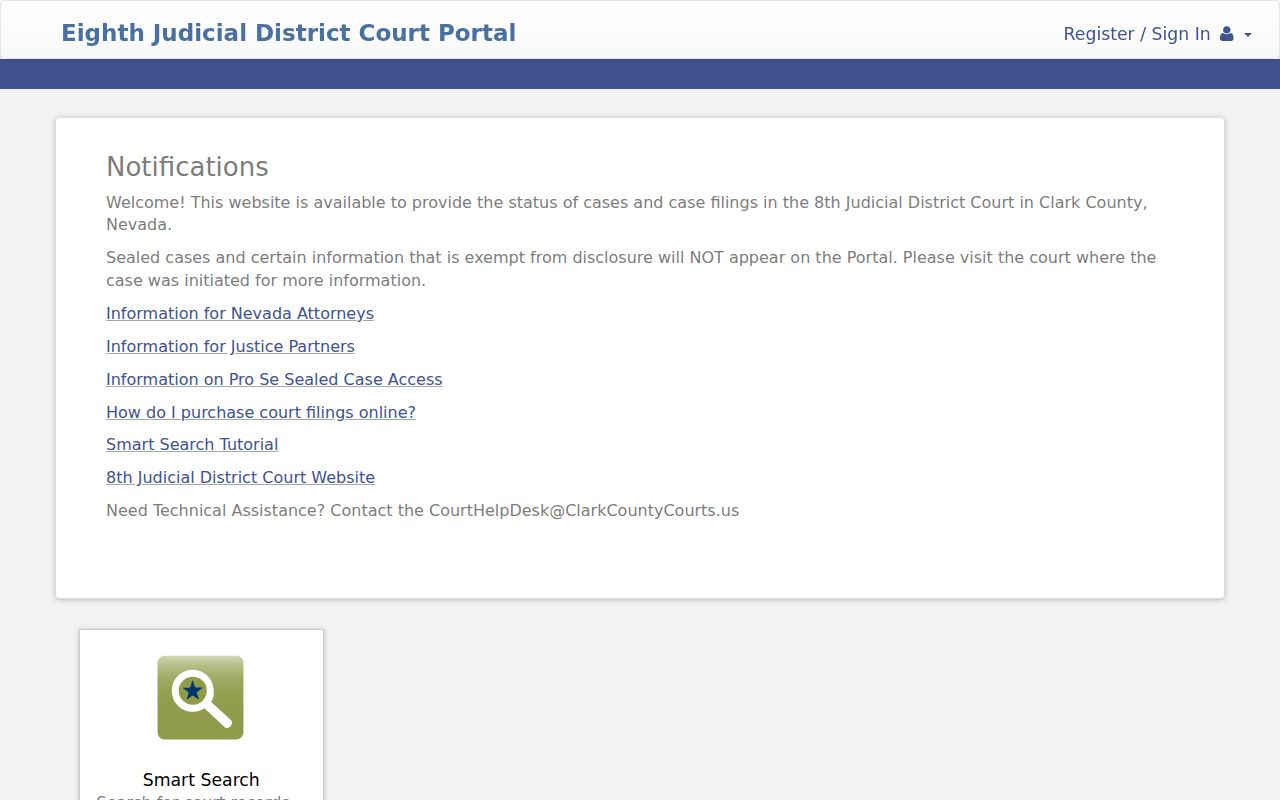
Its fields help find one judicial district's records, but the screen is not a Nevada-wide court search.
A separate Justice Court public-access channel demonstrates that limited-jurisdiction cases may sit in another system.
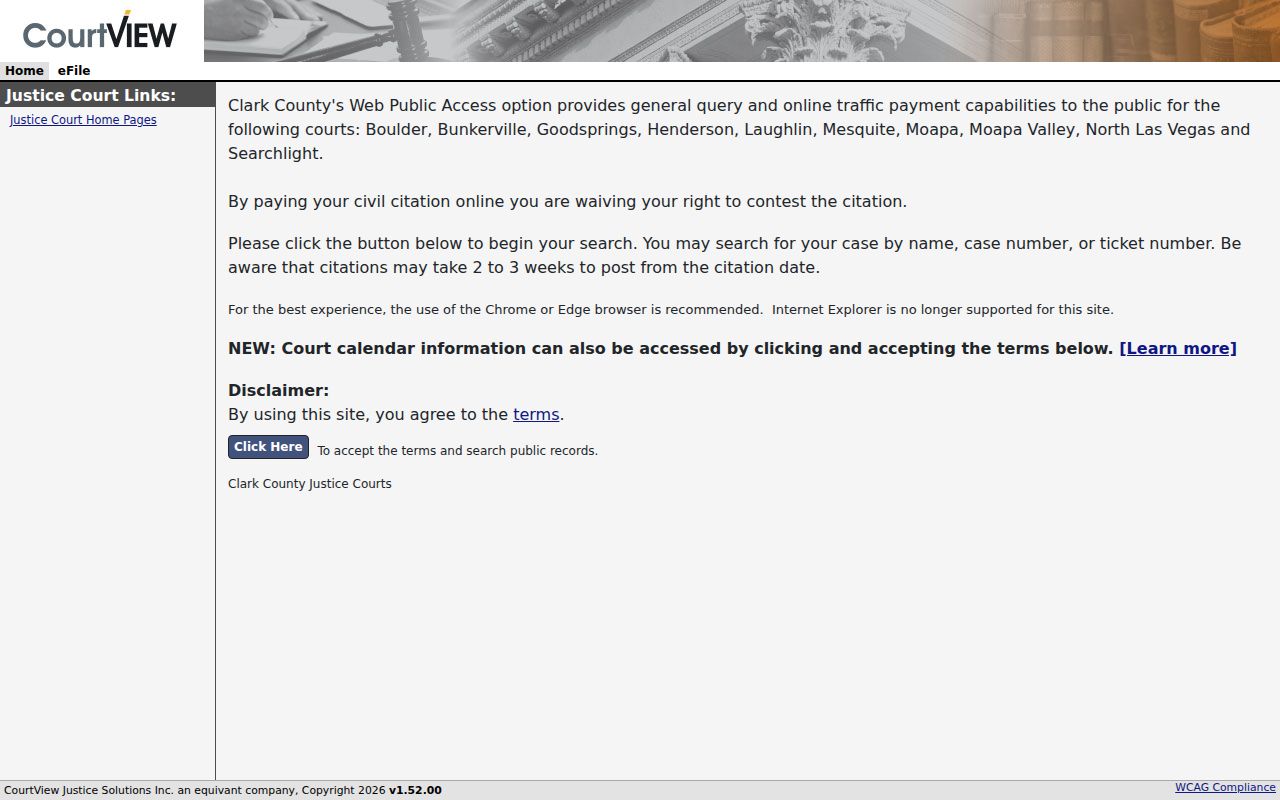
Checking both levels can be vital when a Nevada felony began with a Justice Court complaint and later moved into District Court.
Stages of a Nevada Criminal Case
A Nevada criminal case may begin with an arrest or summons and a complaint. The first appearance addresses the filed allegation and release. A felony or gross misdemeanor can receive a preliminary examination in Justice Court before bind-over, unless that step is waived or an indictment changes the path. District Court then receives an information or indictment, holds arraignment, and records the plea.
Pretrial motions and negotiations follow. The matter may end through dismissal, a negotiated plea, or trial. An acquittal is not a conviction. A guilty plea or verdict still needs the judgment and sentence entry to show the final outcome. If appealed, a new appellate docket is created, but the local trial record remains the source for the underlying pleadings and judgment.
Case flow: Charges Filed › Arraignment › Pretrial › Plea or Trial › Disposition › Sentencing
Read Nevada Criminal Dockets Carefully
A docket is a timeline, not a verdict summary. An initiating charge can be amended, dismissed, or replaced. “Open” or “pending” means the matter lacks a final disposition. “Closed” means the court recorded an end point, but it does not by itself mean guilty. A bench warrant is a court command to arrest, often tied to failure to appear or comply; it is not a new conviction.
- Disposition
- The formal conclusion recorded at a point in the Nevada proceeding.
- Bind-over
- The transfer of a felony or gross-misdemeanor matter from Justice Court toward District Court.
- Information
- A prosecutor's formal District Court charging document.
- Acquittal
- A not-guilty outcome after trial.
- Sealed
- A legal status that blocks ordinary public access without destroying every official record.
Nevada Electronic Filing and Conversion Rule 14 gives electronic records the same confidentiality as paper records. Sealed filings, protected victim or minor data, presentence reports, and personal identifiers may be absent or redacted. A blank field or missing document can reflect access limits rather than a missing case.
Note: Match names with public case context, and never merge two Nevada records solely because the names look alike.
Finding Case Records by County
The full Nevada trial file stays with the clerk of the District, Justice, or Municipal Court that processed the case. The Administrative Office of the Courts holds administrative and aggregate material, not each local docket. Judicial records also do not use the Nevada Public Records Act in the same way as executive-agency files. Court rules and the custodian court's access process govern the case documents.
Use the directory of all 17 Nevada county equivalents to find the correct local criminal-record route. If the alleged conduct occurred inside an incorporated city, also check its Municipal Court. If a felony began in Justice Court, follow it into District Court. When online access stops at a docket, ask the clerk for the filed complaint, judgment, sentence, or certified copy. Nevada law lists a base District Court copy fee of $0.50 per page, $3 for a clerk-seal certificate, and $1 for each year searched, while local portal and other lawful charges can differ.
Nevada Court Record Access Limits
Nevada public access has firm boundaries. The electronic-court confidentiality rule keeps confirmed confidential records out of public view. Sealing under Nevada law removes qualifying records from ordinary lookup channels. Juvenile material, victim and minor information, medical content, presentence reports, and protected investigative evidence may also be withheld or redacted.
The Nevada Public Records Act can provide a route to an executive or local agency, such as an arresting agency, but it does not turn the court's file into an agency record. The police incident report and the criminal court case are separate records. Request each from the office that created it, then reconcile the arrest charge with the court's final signed disposition.