
About the Central Repository for Nevada Records of Criminal History
The full office is the Central Repository for Nevada Records of Criminal History. It sits in the Records Bureau of the Nevada State Police Records, Communications and Compliance Division, within the Department of Public Safety. NRS 179A.075 creates the Central Repository and makes it Nevada's clearinghouse for criminal-history and crime-statistics information. Its mission combines complete, timely, accurate justice data with individual privacy.
The Records Bureau does more than keep rap sheets. Published programs include Criminal History and Fingerprints, the Civil Applicant Program, Civil Name Check, firearms point-of-contact checks, the State Sex Offender Registry, Uniform Crime Reporting, and NCJIS Compliance. The compliance unit manages access, training, and audits. This structure explains why the Repository can receive a fingerprint transaction, add a court disposition, support an authorized civil channel, and publish statewide crime data without turning the central file into an open people-search database.
The Nevada State Police Records Bureau overview maps those programs.
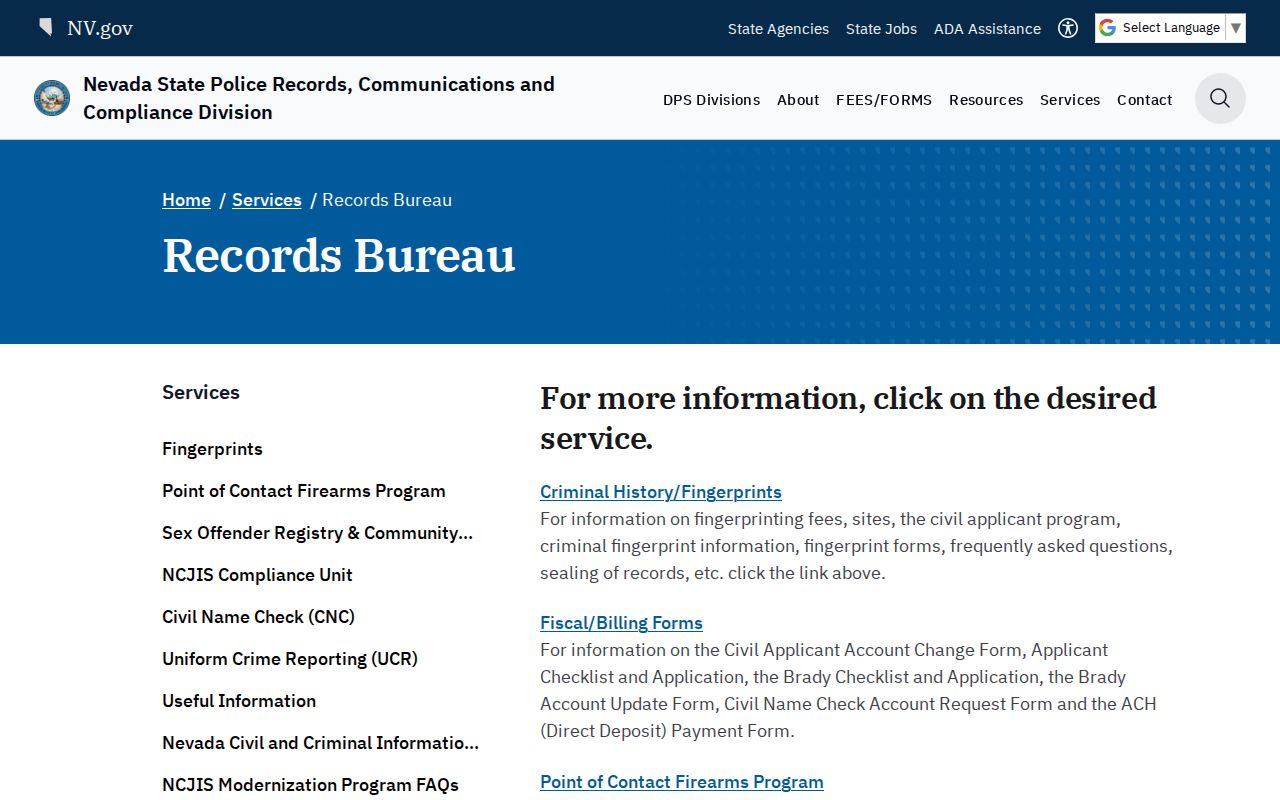
The bureau view places criminal-history service inside a wider system of records, statistics, registry, and compliance work.
Nevada Criminal History Repository Since 1985
The official Repository history begins with the 1985 Nevada Legislature. The new unit started within Nevada Highway Patrol as a statewide “filing cabinet” for arrests, wants and warrants, protection orders, and court dispositions.
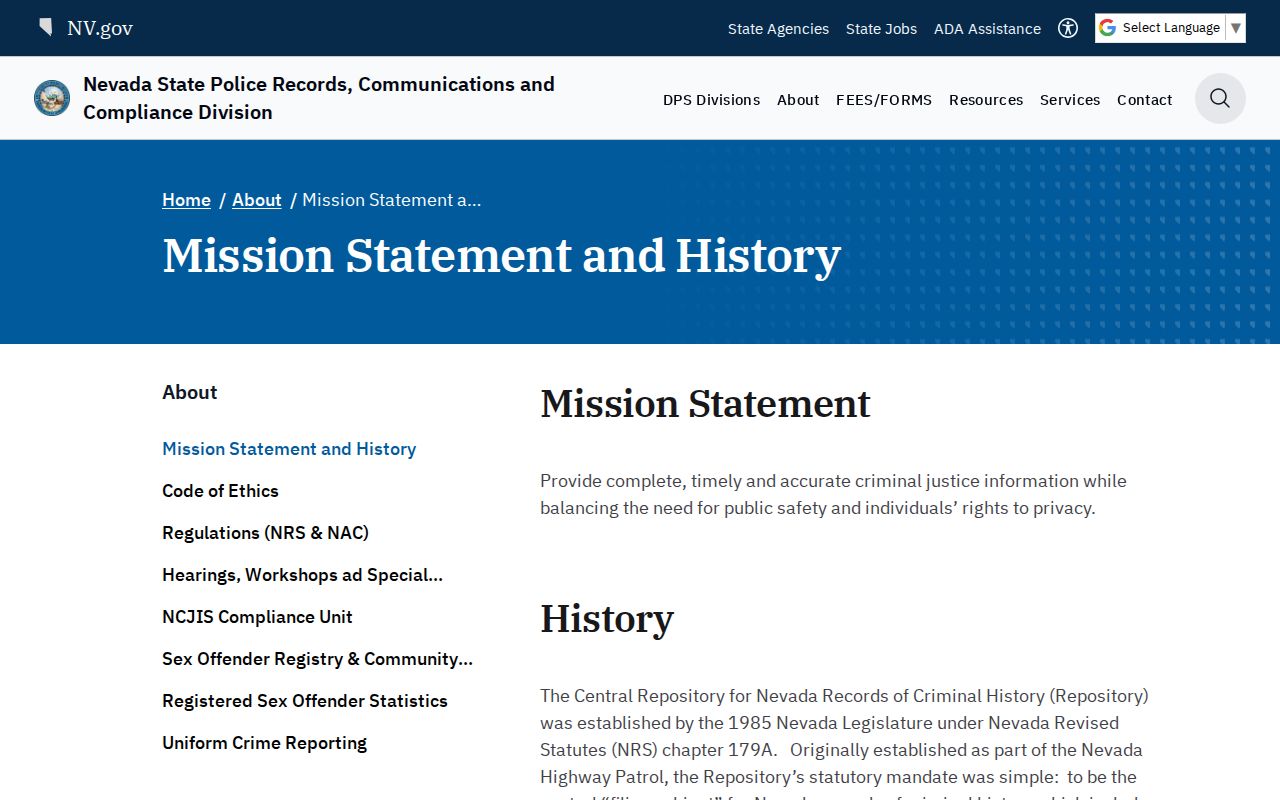
The timeline shows how a paper-centered clearinghouse grew into Nevada's fingerprint-based criminal information network.
Functions arrived in stages. Civil-applicant fingerprint checking began in 1988. The firearms point-of-contact program followed in 1994, Civil Name Check in 1998, and the State Sex Offender Registry in 1999. A 2005 reorganization moved the unit out of Highway Patrol and named the Records Bureau. Later consolidations led to today's Records, Communications and Compliance Division.
Modernization continued. Nevada joined the FBI National Fingerprint File on July 15, 2025 as the 27th member state. Nevada now maintains the state criminal-history record while the FBI index points authorized interstate users to Nevada, reducing duplicate storage. This does not make the file public. It changes how approved justice and civil channels exchange biometric records.
Criminal History Checks Offered by Nevada Criminal History Repository
The Nevada Criminal History Repository leads with self-review. A person can request their own fingerprint-supported Nevada history through NCCIS Personal ID or the manual DPS-006 packet. In-person DPS-008-I is inspection only. Civil Name Check is limited to authorized contracted users under Nevada law and consent rules. It is not an unrestricted public name-search product. Statutory programs may also submit state and FBI fingerprints through the channel supplied by the responsible agency.
| Product | Who May Order | What It Returns | Cost |
|---|---|---|---|
| NCCIS Standard, Certified, or Notarized PID | The subject; electronic initiation inside Nevada | Fingerprint-supported Nevada record or no-record response; delivery varies by option | Shown at portal checkout |
| DPS-006 manual request | The subject; required for out-of-state requests | Complete Nevada-only positive record or negative letter | $27 plus separate capture costs |
| DPS-008-I inspection | A person who is or may be the subject | In-person inspection of that person's Nevada history only | No copy is provided |
| Civil Name Check | Authorized contracted participants | Nevada name and numeric identifier search | $20 |
| Regular state and FBI fingerprint submission | Authorized statutory agency or program | Program-defined Nevada and FBI response | $39, plus possible capture fee |
| Qualified volunteer fingerprint submission | Qualified program or organization | Program-defined state and FBI response | $31.50, plus possible capture fee |
Fees shown are official processing amounts. A law-enforcement or private fingerprint site may add a capture charge. The requesting program controls its own authorized workflow, so users should never invent a service code or replace a program submission with the personal DPS-006 route.
Nevada Criminal History Repository Starts With Prints
Nevada's computerized criminal history is part of the Nevada Criminal Justice Information System and is based on fingerprints for positive identification. RCCD reports receiving about 75,000 new criminal fingerprint cards each year. Felonies, gross misdemeanors, and misdemeanors are indexed. Routine traffic charges are not, with DUI as the stated exception. A fingerprint-supported file is less likely to merge two people who share a name.
This foundation also sets a boundary. An incident report, intelligence file, or unbooked citation may never become a criminal arrest cycle in the central system. NRS 179A.070 defines the formal transactions that can form Nevada criminal history and excludes investigative material, crime reports, most juvenile information, wanted-person posters, and some court indexes. The Repository keeps criminal arrest fingerprint cards until it learns the subject died or receives a sealing order.
The RCCD fingerprint and fee center collects the current forms and official processing schedule.
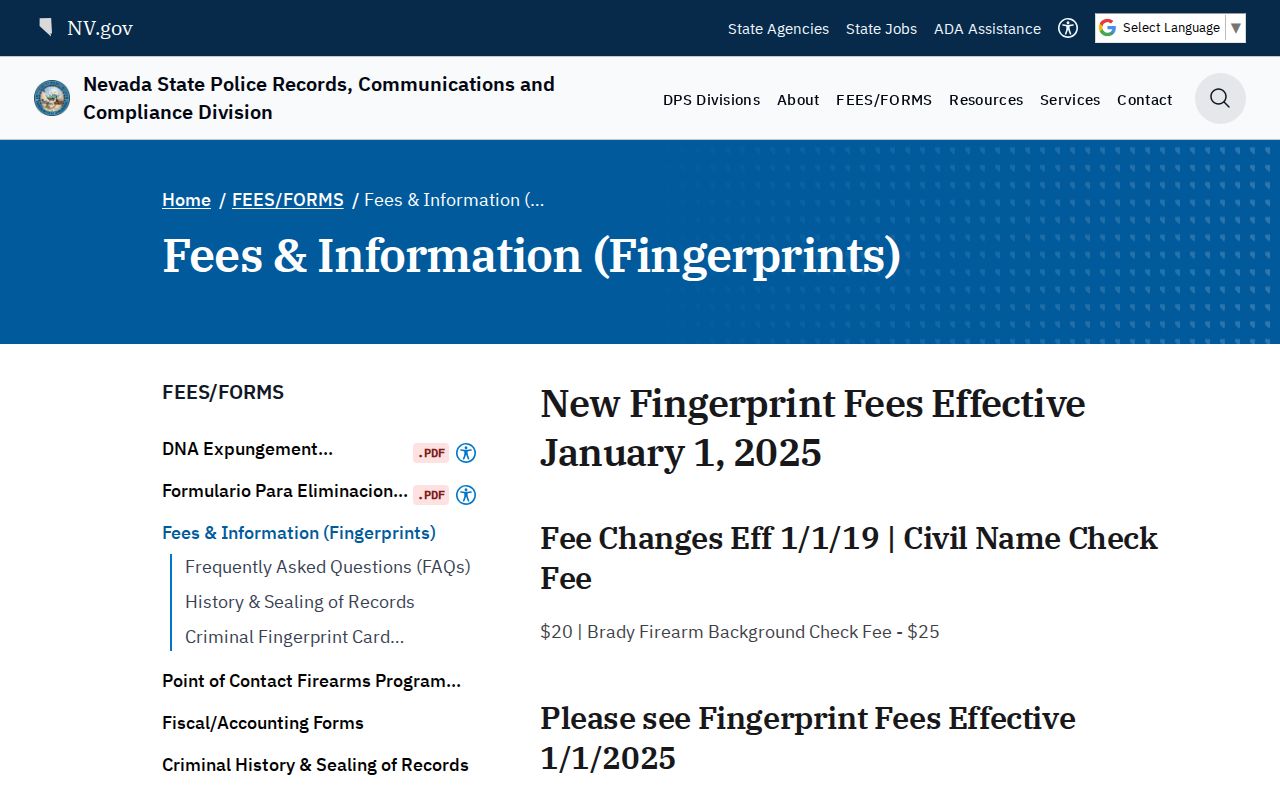
Those official forms matter because the correct print card, payment, and channel determine whether RCCD can process a request.
Note: A name can narrow a search, but fingerprints establish identity for a personal Nevada Repository review.
How Records Flow Into the Nevada Criminal History Repository
A Nevada sheriff, municipal police department, Nevada State Police unit, or other justice agency creates the arrest record. If an adult is booked for a reportable charge, staff take fingerprints by LiveScan or card and send the fingerprint transaction to the Central Repository. The local case then moves in the proper District, Justice, or Municipal Court. That court's clerk keeps the docket and source documents.
Data flow: County Arrest › Fingerprint Submission › Central Repository for Nevada Records of Criminal History › Court Disposition Reporting › Rap Sheet
NRS 179A.075 requires Nevada criminal-justice agencies to submit criminal-history information within 60 days after disposition. The Repository links that later result to the fingerprint-backed arrest cycle. A rap sheet may then show arrest, charges, dismissal or conviction, sentence, incarceration, and supervision. It still is not the court file. Reporting lag, an older event, poor prints, a name variant, or an unmatched disposition can leave the state summary and local docket out of sync.
Coverage is stronger for history from 1987 forward. RCCD directs a person seeking earlier information back to the arresting agency. Even for a newer case, verify an entry against the county court's judgment when exact wording or current status matters.
Nevada Criminal History Repository Is Not People Search
Nevada does not offer the general public an open Repository name search of another person's statewide file. The public-facing products let a subject obtain or inspect their own fingerprint-verified Nevada history. Civil Name Check is different. Contracted and authorized participants use it under NRS Chapter 179A with the required legal basis and consent. Its $20 fee does not turn it into a public people-search option.
That limit protects the difference between a name similarity and biometric identification. It also directs ordinary public research to the actual public systems. A person examining a court matter can search the court that heard it. Booking and incident material remains with the local custodian. The sex offender registry publishes the categories that Nevada law specifically authorizes for community notice. None of these public channels is a substitute for the subject-only Repository file.
For a national self-review, the FBI Identity History Summary is a separate subject-only fingerprint process. It does not replace Nevada's state-only record when the question is whether the Nevada Repository has matched a disposition or processed a sealing order.
How to Order a Nevada Criminal History Repository Check
Choose the route by where the request starts and what form of response is needed. The NCCIS Personal ID gateway supports Standard, Certified, and Notarized PID options for transactions initiated inside Nevada.
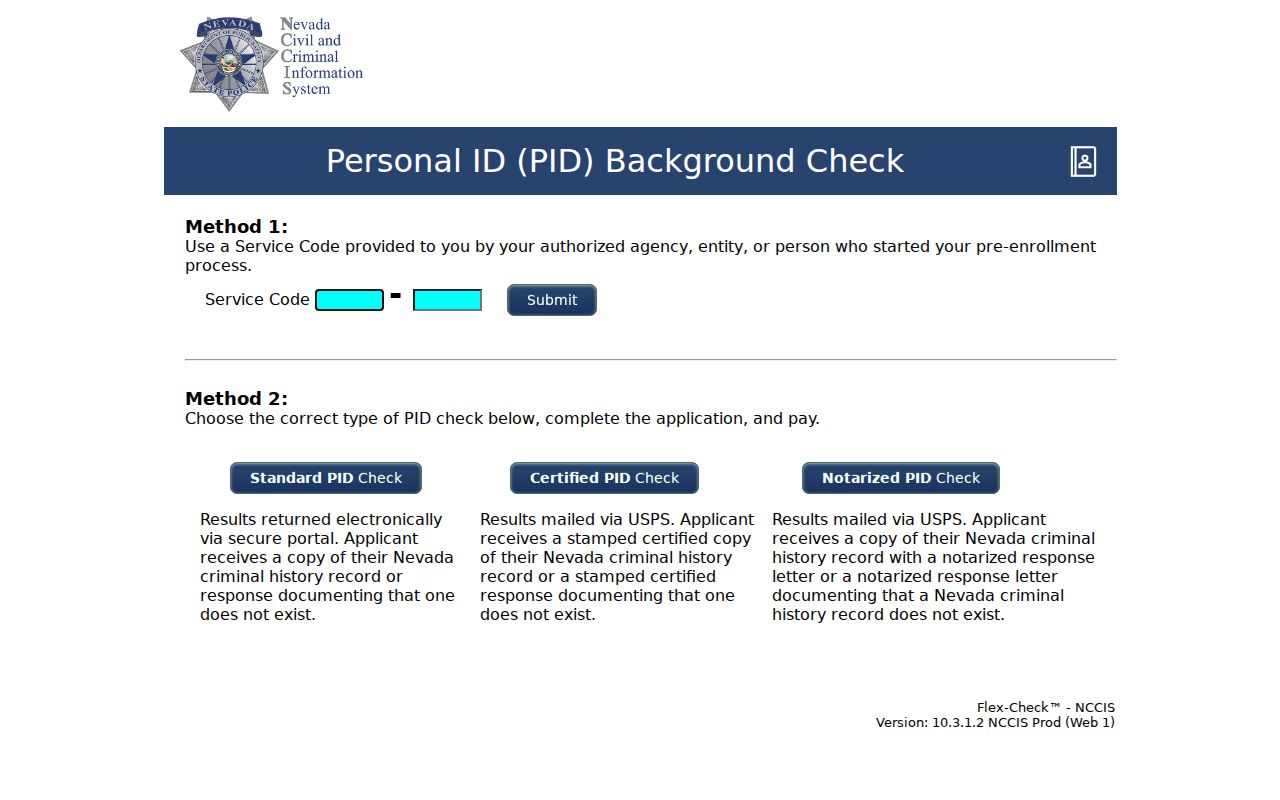
The gateway selects the product before applicant details and fingerprints are completed, which confirms that PID is not a name-only lookup.
- Choose Standard PID for secure electronic delivery, Certified or Notarized PID for the stated mail response, or DPS-006 when requesting from outside Nevada.
- Complete the application and follow its identity instructions. Each person needs a separate transaction.
- Obtain the required fingerprint capture from a Nevada law-enforcement site or authorized private service. A DPS listing is not an endorsement.
- Pay the amount shown for the selected portal product, or enclose exactly $27 by certified check or money order with DPS-006.
- Save a Standard PID result within its 30-day online window. Compare any disputed entry with the county source file.
RCCD's current manual form says to allow about 45 days after receipt. The FAQ describes 30 calendar days plus roughly two weeks for mail and delivery. These statements point to much the same planning window. Incomplete packets are returned.
Nevada Criminal History Repository DPS-006 Packet
Out-of-state subjects must use the manual DPS-006 process. It also remains an in-state paper alternative. The form requires the subject's full name, mailing address, contact phone and email, signature, date of birth, signing date, response address when different, and reason for the request. A conditional certification appears for the statutory trafficking-victim fee exception.
Attach one original FD-258 fingerprint card. The card needs name, birth date and place, sex, race, height, weight, hair and eye color, all ten rolled impressions, the plain impressions, the subject's signature, and the date and signature of the certified technician. Copies and cards already processed are rejected. Payment must be the exact $27 amount by money order or certified check payable to Nevada Department of Public Safety. Cash and personal checks are not accepted.
The official Nevada criminal-history request options distinguish electronic PID, manual submission, and delivery types.
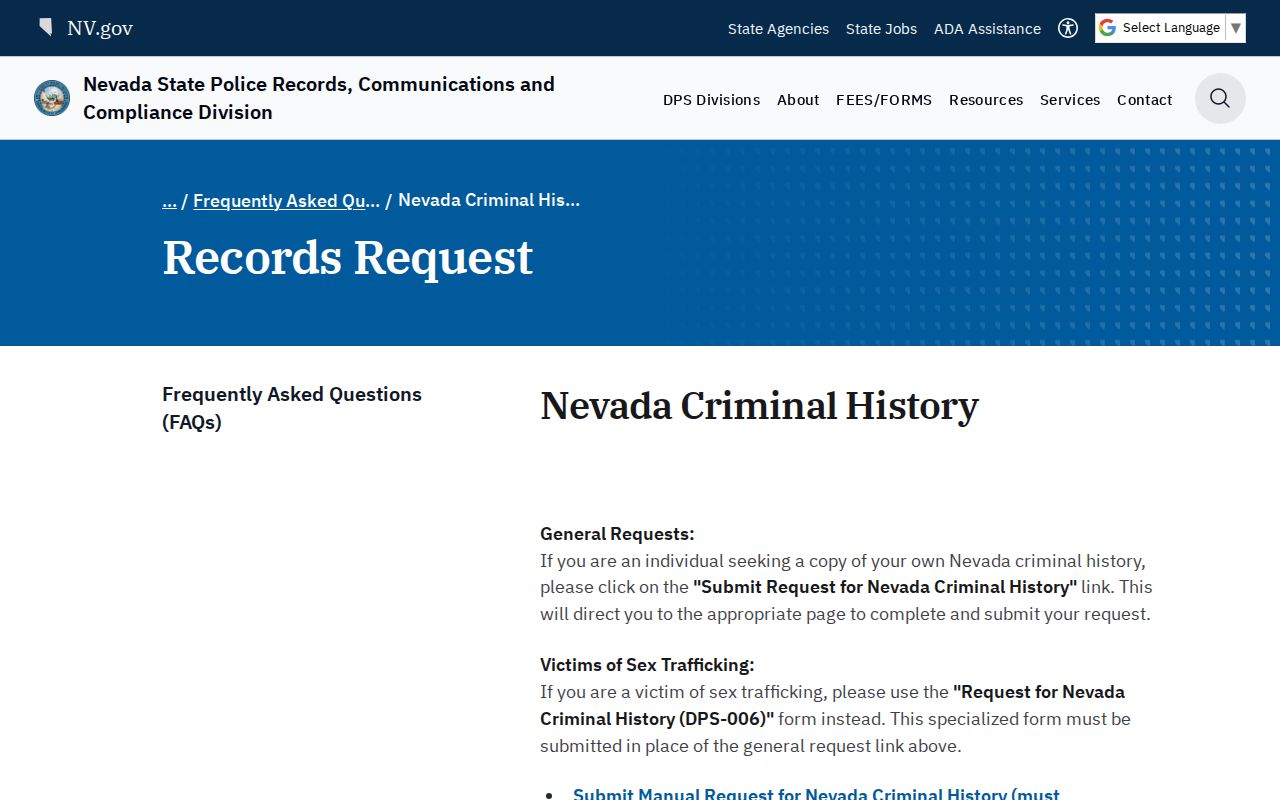
The choice changes capture, payment, delivery, and timing, but each personal record route relies on fingerprints.
Nevada Criminal History Repository Checks vs County Records
The Repository and local offices answer different questions. A statewide rap sheet compiles formal transactions tied to fingerprints. The county holds the original booking entry, incident report, docket, filed motions, judgment, and other source documents. Neither replaces the other. Use the Nevada county directory to reach the clerk or local agency that created a missing, old, or disputed transaction.
| Nevada Repository Check | County Records | |
|---|---|---|
| Coverage | Compiled Nevada history across all 17 county equivalents | Arrests and cases held by one local custodian |
| Source | Fingerprint-backed arrest cycles and reported dispositions | Original jail, police, prosecutor, and court files |
| Freshness | Depends on submission and matching | Changes as the local case moves |
| Detail | Formal summary transactions | Docket events, orders, reports, and filed documents |
| Best for | Reviewing the subject's statewide Nevada rap sheet | Confirming an entry and reading the source record |
A “no Nevada record” response does not prove no local case ever existed. A pre-1987 event, an unbooked citation, a pending match, or an excluded source document may remain outside the returned statewide file.
Nevada Criminal History Repository Inspection or Copy
DPS-008-I permits the subject, or a person who believes they may be the subject, to inspect the Nevada history held by the Repository in person with valid government identification. It covers Nevada criminal-history information. It excludes investigative and intelligence files, FBI records, and records from other states. The inspection cannot be removed, copied, photographed, or noted.
PID and DPS-006 serve a different need because they return a response the subject can retain. Standard PID delivers through a secure portal and remains available for 30 calendar days. Certified and notarized choices arrive through the mail. DPS-006 returns either a negative-response letter or a positive letter with the complete Nevada record. Choose inspection for a controlled look at the Nevada file. Choose PID or DPS-006 when a copy is needed for personal review and correction.
Note: The no-copy inspection rule is strict, so use a personal record request when documents must be compared outside the Repository counter.
Correcting Errors in Your Nevada Criminal History Repository Record
Only the subject may challenge the accuracy of their Nevada Repository record. Begin with PID, DPS-006, or the inspection channel. DPS-008-X asks for the disputed arrest date, case number, arresting agency, charges, and claimed error. Useful support includes a final court disposition, arrest report, or charging complaint. A direct challenge also needs an original FD-258 fingerprint card with full identity and technician details.
- Obtain your Nevada record and mark the exact arrest or disposition line that appears wrong or incomplete.
- Compare it with the final source record from the court or arresting agency that created the transaction.
- Submit DPS-008-X with fingerprints and supporting documents. RCCD forwards the dispute to the originating justice agency.
- Allow up to 90 days, then confirm the correction on a fresh Repository response.
NRS 179A.150 provides the challenge basis and requires corrected dissemination. NRS 179A.160 offers a separate route to remove certain favorable-result arrests, citations, or warrants from generally searched inquiry files, subject to exceptions. That is not the same as a Chapter 179 court sealing order.
Nevada Criminal History Repository After Record Sealing
Nevada record sealing restricts dissemination but does not destroy the file. When a court enters an order, the order must reach the agencies named in the case, including the Central Repository when appropriate. The Repository then suppresses the sealed transaction under Nevada law. Processing does not rewrite the local case instantly across every system, so a subject should keep a certified order and verify that the state record reflects it.
A sealing issue belongs first with the court that entered the order and the agencies listed for service. A missing disposition or incorrect identity link belongs in the Repository challenge process. These routes solve different problems. If the Repository still shows a transaction after receiving the sealing order, provide the order and enough case data for RCCD and the source agency to locate the entry.
Older and newer records can fail for different reasons. Pre-1987 coverage may require the arresting agency. A recent case may still await disposition reporting or matching. The best correction path starts by naming the exact transaction, finding its source, and choosing challenge, favorable-result removal, or sealing verification based on what is actually wrong.