
How to Check Criminal History in Nevada
Start with the question the record must answer. A person reviewing their own statewide Nevada history can request the fingerprint-linked response maintained by the Central Repository for Nevada Records of Criminal History. Someone tracing a filed charge or outcome needs the trial court docket and its signed documents. A recent booking belongs to the local jail, while a sentenced state prisoner may appear in the Nevada Department of Corrections system. Registry, parole, warrant, and police-report records each follow another path. These sources overlap, but none replaces the others.
Names alone can match the wrong person. Use a case number, booking number, offender ID, date of birth, court, or event date when the official form allows it. Read the status and source date, not just a charge label. A dismissal or amended count may appear later in a case file than the first arrest entry. Nevada records also can lag when a final disposition has not yet linked to its fingerprint-supported arrest cycle.
- Choose the record type and decide whether it is your own record or a public government file.
- Use the Nevada repository for a fingerprint-based self-review, not an unrestricted search of another person.
- Identify the county and court for a charge, judgment, booking, report, or warrant.
- Check NDOC, the parole system, or the public registry only when that statewide system fits the question.
- Order a certified copy from the office that created the record when proof is needed.
Note: A repository response is a compiled history; the county court file remains the source for pleadings, orders, and the signed judgment.
Nevada Personal Record Review
Nevada does not offer an open repository name search for the public. The official route is self-review. A person inside Nevada may start with the NCCIS Personal ID gateway, choose a standard, certified-mail, or notarized-mail result, complete payment, and follow the fingerprint steps. Electronic initiation is limited to Nevada. An out-of-state requester uses the manual DPS-006 packet with an original FD-258 fingerprint card.
The portal landing screen is a service and payment gateway, not a public name-and-date-of-birth query. Each person needs a separate transaction. A standard result stays available through the secure portal for 30 calendar days. Manual requests cost $27 before the separate fingerprint-site charge and take roughly the planning window described by the form: about 45 days after receipt. The response is Nevada-only and generally covers fingerprint-supported history reported from 1987 forward.
| Channel | Who Uses It | Scope |
|---|---|---|
| NCCIS Personal ID | Subject initiating inside Nevada | Fingerprint-supported Nevada self-review |
| DPS-006 by mail | Subject, including out-of-state requester | Nevada record with original fingerprint card |
| County court search | Public case researcher | Docket, charges, orders, and disposition |
| FBI Identity History Summary | Subject reviewing federal identity history | Separate nationwide FBI-maintained record |
The Nevada Criminal History Repository
The Central Repository for Nevada Records of Criminal History sits in the Records Bureau of the Nevada State Police Records, Communications and Compliance Division. It maintains Nevada's fingerprint-based computerized criminal history within NCJIS. Reportable felonies, gross misdemeanors, and misdemeanors can enter the index. Routine traffic charges do not, with DUI as the stated exception because it may rise to felony level. The Repository receives about 75,000 new criminal fingerprint cards per year.
NRS 179A.075 directs Nevada criminal-justice agencies to submit prescribed criminal-history information. The Repository can link an arrest cycle with formal charges, a dismissal or conviction, a sentence, custody, and supervision. It does not absorb the full police narrative or every paper in the court case. A missing or late local outcome can cause the compiled history to differ from the docket. For that reason, Nevada's fingerprint response and the source-court file should be read together when an entry is unclear.
How Nevada Records Reach State
The record starts where the event occurs. Police or a sheriff creates the incident or arrest report. A jail creates a booking entry and takes prints if the person enters custody. Prosecutors decide whether to file, change, or decline charges. Justice and Municipal Courts handle their limited-jurisdiction work, while felony and gross-misdemeanor matters move toward Nevada District Court. Clerks then maintain the docket, filed papers, orders, plea or verdict, and sentence.
Arrest and booking → fingerprint submission → charging decision → county court disposition → Repository rap sheet. Nevada generally requires disposition reporting within 60 days after the disposition. That rule does not promise an immediate match. Poor prints, older events, a name variant, or a disposition that has not linked can leave a gap. The Repository challenge process sends a disputed item back to its source agency because the originating court or police agency controls the underlying fact.
The official Nevada Find a Court directory shows how readers locate the proper trial court.
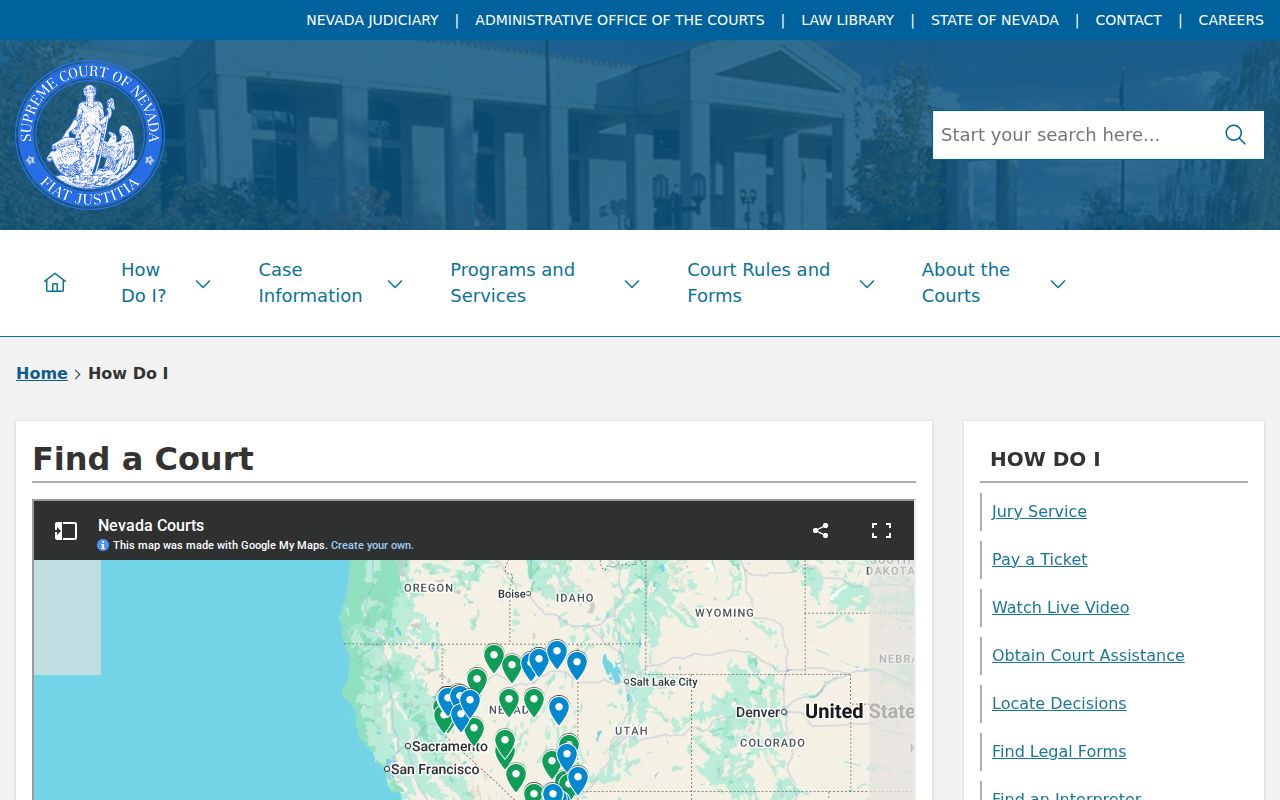
The directory reinforces the central Nevada rule: trial records remain divided among District, Justice, and Municipal Courts rather than one statewide public portal.
Statewide Record Systems in Nevada
Nevada's statewide systems answer narrow questions. The Central Repository compiles reported fingerprint-supported history for the subject's official self-review. The Nevada Department of Corrections tracks people committed to state prison. The public sex offender website publishes the records permitted by Nevada notification law. ACIS covers appellate matters in the Supreme Court and Court of Appeals, but it does not search every Nevada trial case. Local trial dockets still require the correct county and court.
| System | What It Holds | Run By |
|---|---|---|
| NCCIS Personal ID | Subject's Nevada fingerprint history | Nevada State Police RCCD |
| NDOC Inmate Search | State-prison custody and sentence data | Nevada Department of Corrections |
| Nevada Public Sex Offender Registry | Publicly eligible registration profiles | Nevada State Police Records Bureau |
| Nevada ACIS | Supreme Court and Court of Appeals matters | Nevada Judiciary |
| NCJIS warrant file | Operational warrant data, not a public portal | Authorized justice agencies |
Nevada Jail and Prison Split
A recent Nevada arrest usually points to a county or city detention system. There is no consolidated public Nevada county-jail roster. NRS 208.290 requires custodial facilities to maintain and make available a current custody list, but it does not create one statewide website. The Nevada county directory is therefore the right route to the sheriff, detention center, and separate city jail when one exists.
The Nevada Department of Corrections serves a different role. Its free Inmate Search accepts an offender ID or a name route and provides downloadable demographic, alias, booking, parole, and release datasets. A profile may show a photograph, offense and sentence information, current institution, status, and parole or release dates. Projected dates can change. A zero result may mean the person is in local custody, has transferred or been released, uses an alias, or is outside NDOC coverage.
The Nevada Department of Corrections site distinguishes prison records from county detention.
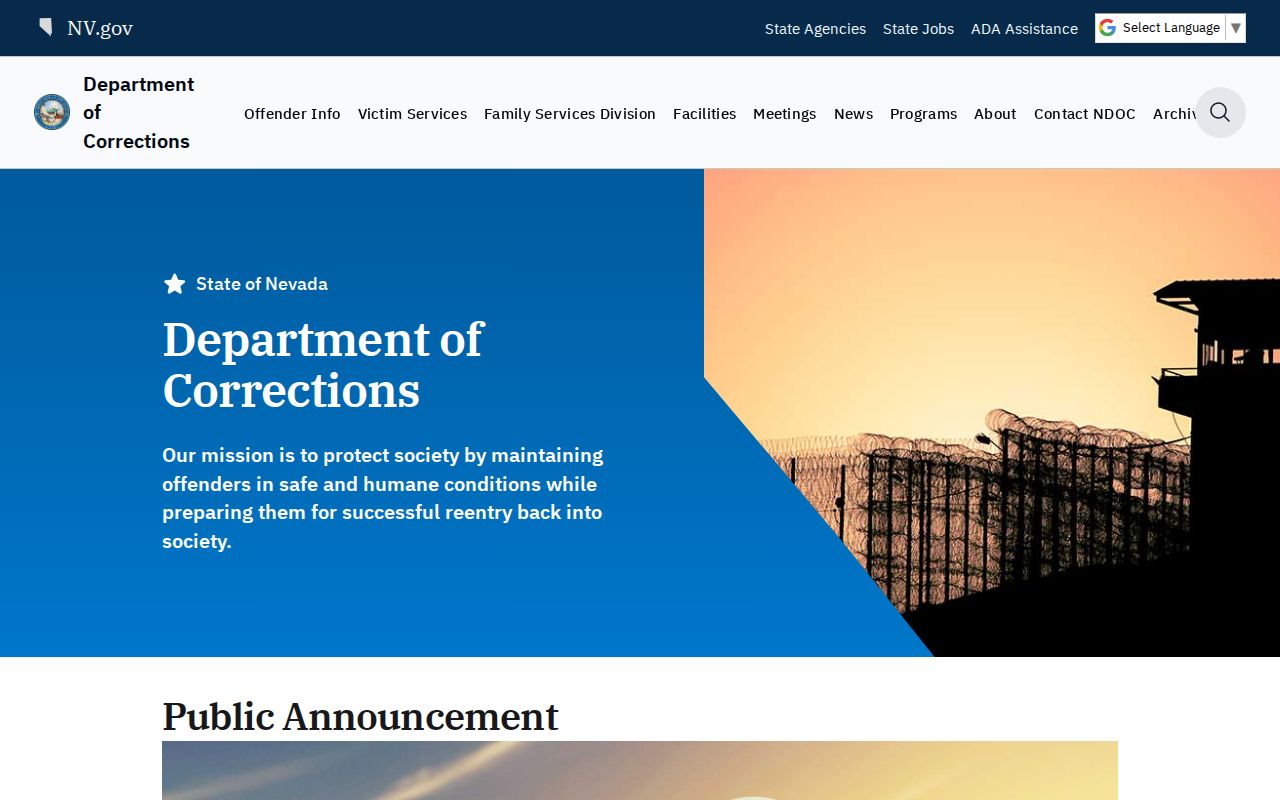
The agency view helps prevent a common mistake: an NDOC search cannot confirm whether someone was booked into a local Nevada jail after a recent arrest.
Types of Criminal Records
Nevada criminal records are separate products with different custodians. An arrest report describes an agency's investigation. A booking record describes intake and current or past local custody. The court file records prosecution and adjudication. The Repository assembles reported arrest cycles and outcomes around fingerprint identity. NDOC records concern state custody, while parole and probation records concern supervision. The registry publishes only data allowed by its own statutes.
- Arrest cycle
- One fingerprint-supported Nevada arrest transaction and the later dispositions linked to it.
- SID
- A State Identification number tied to a fingerprint-supported subject, not a court case or booking number.
- Disposition
- The formal result at a stage of the criminal proceeding, such as dismissal, acquittal, plea, or conviction.
- Booking number
- A local jail identifier for one intake event.
- Docket
- The court's chronological list of filings, hearings, orders, and case events.
A filed charge can first appear in Justice Court and later in District Court. That is normal Nevada case flow, not automatic duplication. The criminal court case record provides the pleadings and judgment that a short index or rap-sheet line cannot.
Nevada Records Beyond Rap Sheets
No public statewide warrant name search exists. NCJIS holds an operational state warrant file for authorized justice agencies, so a blank public search proves nothing. Verify an arrest or bench warrant with the issuing Nevada court and the relevant local agency. Do not go to an office to resolve a possible warrant without first asking the court or counsel about safe procedure.
Probation and parole are state-run through the Nevada Division of Parole and Probation, while release decisions come from the Nevada Board of Parole Commissioners. Hearing schedules and monthly decisions are different from a person's full supervision file. The official Nevada parole hearing schedule illustrates the public statewide layer.
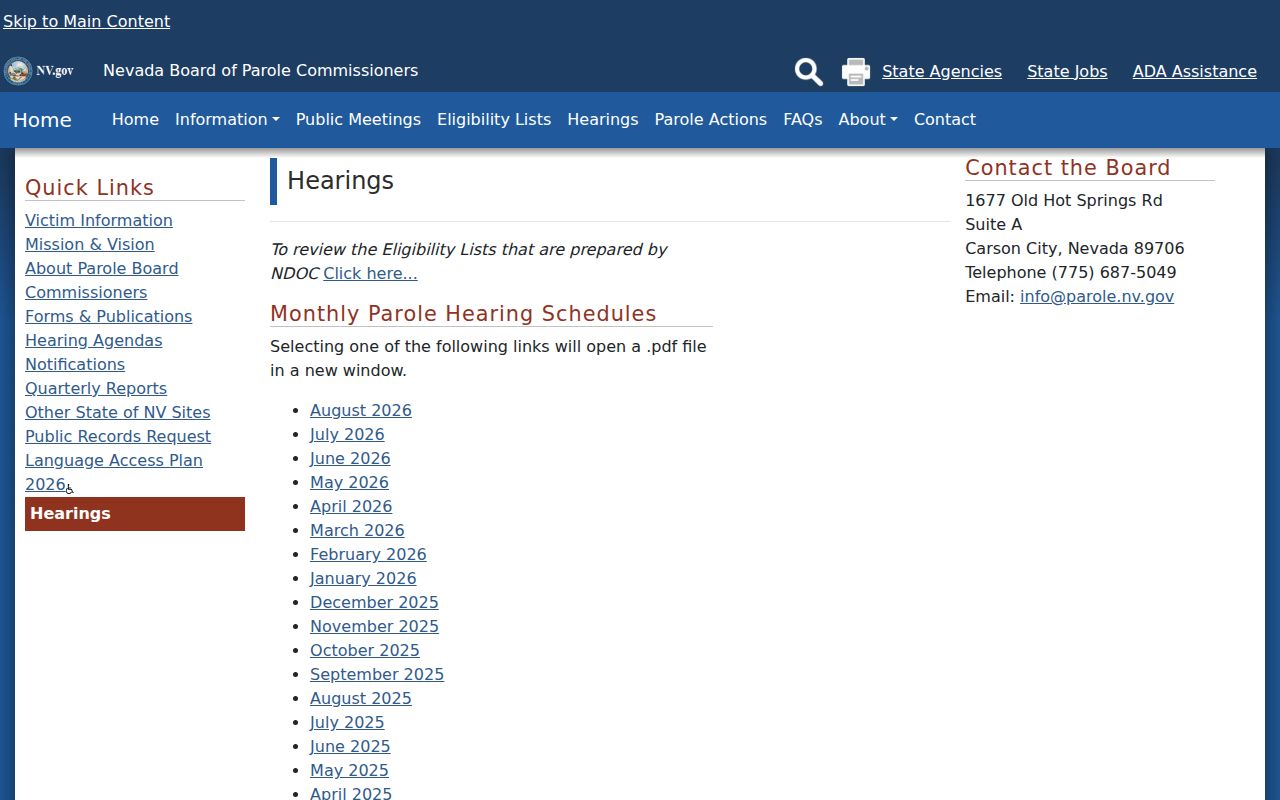
The schedule can confirm a public hearing setting, but it does not replace the sentencing court judgment or a verified supervision record.
Nevada police and incident reports stay with the agency that created them. DPS handles its own divisions, and local departments handle theirs. A Highway Patrol crash report is another distinct product. Its official channel requires the crash number with the NHP prefix, an involved party's last name, and the crash date. The Highway Patrol crash request screen shows those search keys.
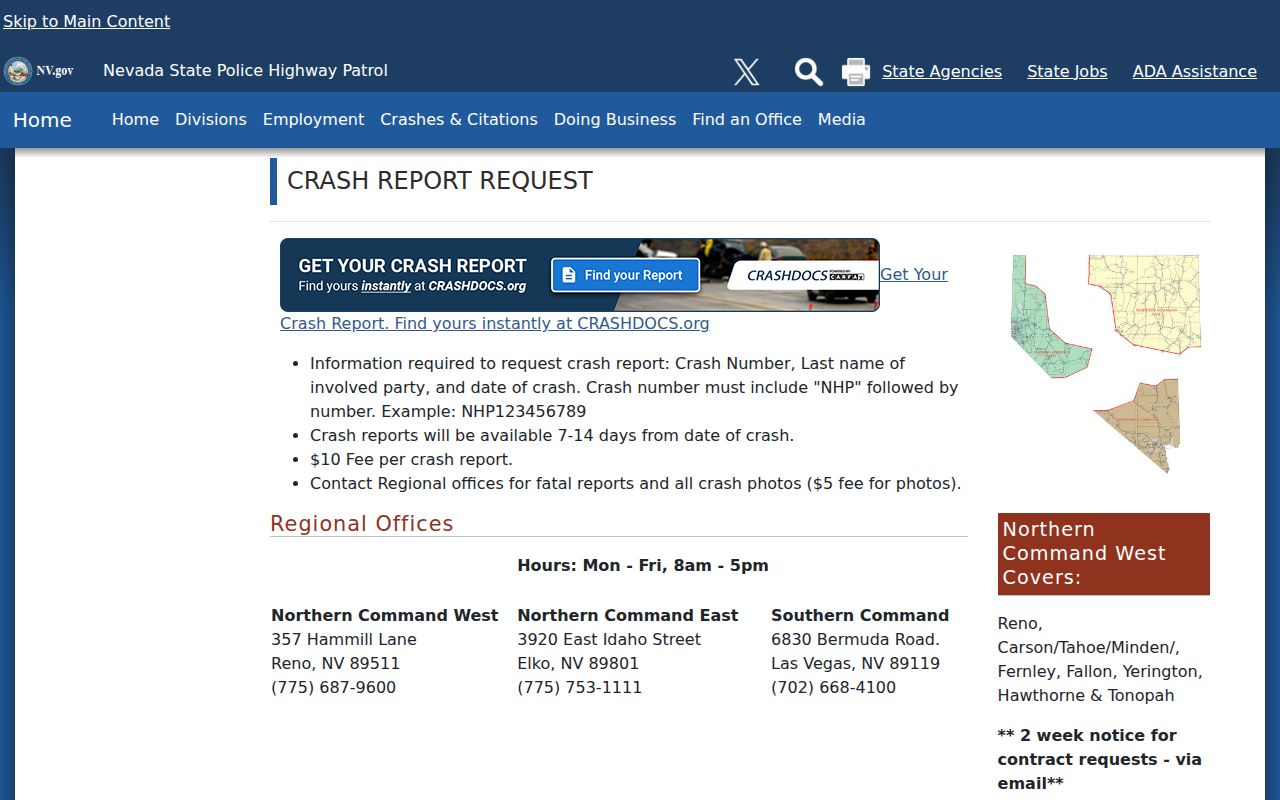
That screen covers Highway Patrol crashes only. It is not a search for every police incident or arrest in Nevada.
Nevada offense labels also need context. Felonies use categories A through E. The state separately recognizes gross misdemeanors and misdemeanors. District Court tries felonies and gross misdemeanors, although a limited-jurisdiction court may handle early proceedings. Justice Courts try state-law misdemeanors, and Municipal Courts try city-ordinance misdemeanors. The specific offense statute controls when its range differs from the general classification.
Public Access Laws
The Nevada Public Records Act, NRS Chapter 239, governs many requests to government custodians. Under NRS 239.0107, an office generally must act by the end of the fifth business day by producing the record, directing the requester to the known custodian, giving a date when it expects the record will be available, or issuing a written denial with legal support. That is a response rule, not a promise that all records are open or complete within five days.
NRS Chapter 179A separately controls criminal-history collection, access, dissemination, inspection, and correction. Court rules and statutes protect sealed cases, juveniles, victims, personal identifiers, active investigations, and other confidential material. Public access to a docket also does not make every filed document public. Ask for the narrow record, identify the event and agency, and expect lawful redaction where protected facts mix with releasable content.
Key Nevada statutes:
NRS Chapter 239 sets the public-record request and fee framework.
NRS Chapter 179A governs the Central Repository and criminal-history dissemination.
NRS Chapter 179 contains adult record-sealing procedures.
NRS Chapter 62H restricts and generally auto-seals juvenile records subject to exceptions.
The Nevada DPS public-record request page shows the statewide request form for DPS-held material.
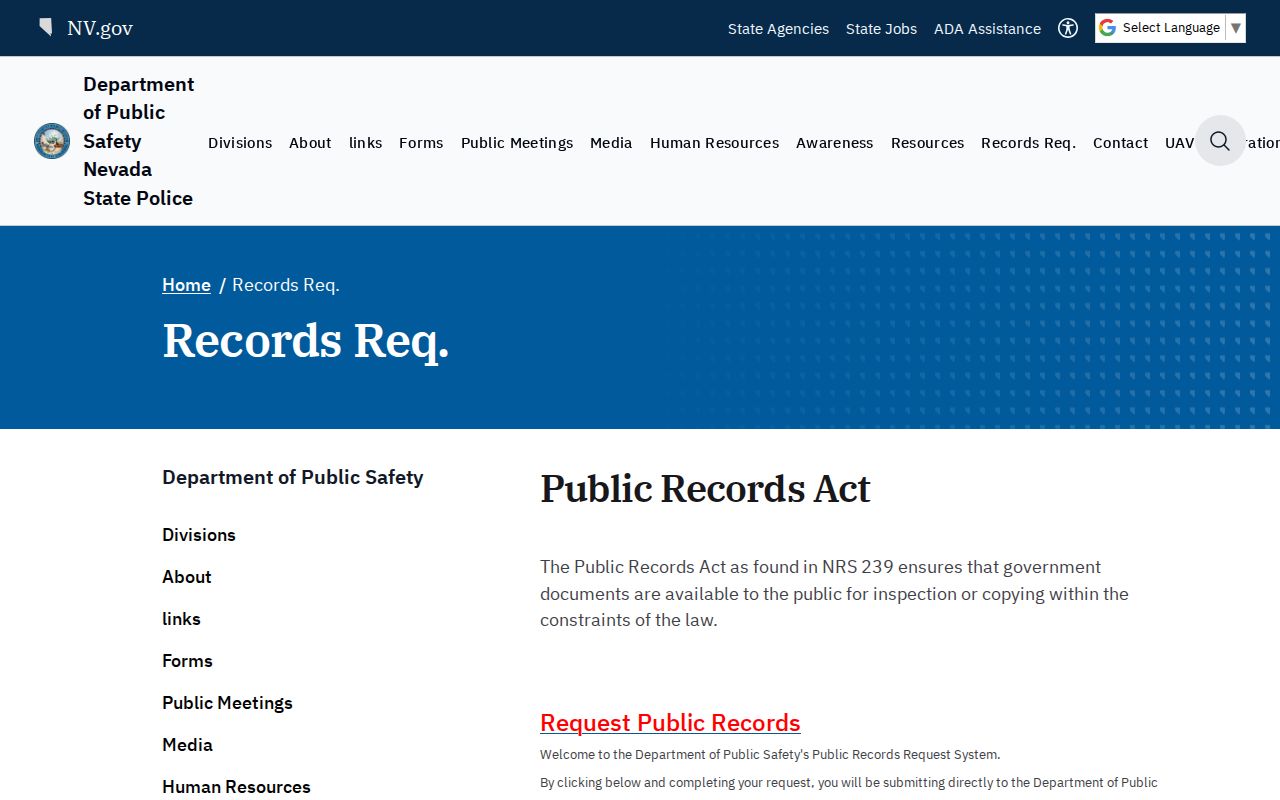
Its fields focus the request on a specific record, format, and delivery method, which helps DPS identify the right division and custodian.
Nevada Record Sealing Route
Record sealing is Nevada's main adult record-clearing term. Sealing restricts ordinary dissemination but does not destroy every copy. Eligibility depends on the outcome, offense, waiting period, and statutory exclusions. NRS 179.245 generally measures a conviction waiting period from release from actual custody or discharge from parole or probation, whichever is later. Other routes may apply when prosecution was declined, charges were dismissed, or the person was acquitted.
The process begins with a current fingerprint-based Nevada history so each arrest cycle can be identified. Collect missing dispositions from the source court or arresting agency. The petition and proposed order must accurately list the arrests, charges, outcomes, courts, prosecutors, and custodians that hold the records. Procedures vary by county. A Nevada sealing filing therefore happens in the appropriate county court, not at a single statewide counter.
Nevada State Police publishes separate record-sealing form sets for District Court and for Justice or Municipal Court matters.
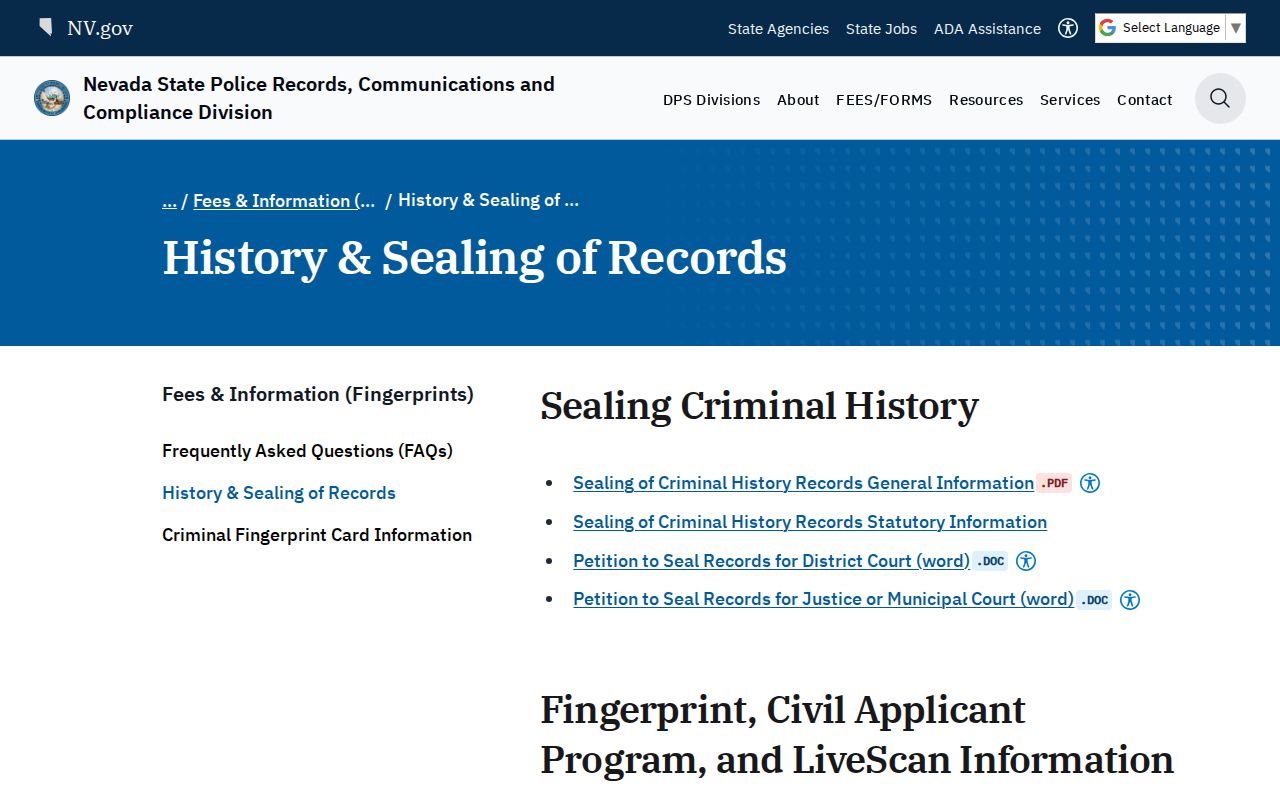
The separate packets reflect the local court path. After a judge signs an order, it must reach the Repository and every named custodian for the Nevada records to be restricted.
Note: Nevada State Police warns that Repository processing after receipt of a sealing order may take up to six months.
Find Criminal Records by County in Nevada
Arrests, bookings, police reports, and trial files begin with Nevada's local agencies and courts. The six largest county areas illustrate why location matters. A metro may have several courts and detention sources, while a rural county may rely on a smaller set of offices spread across long distances. Carson City is an independent consolidated city and Nevada county equivalent. Each card below leads to a deployment URL placeholder because the apex domain was not supplied with the project.
Clark County
Las Vegas · Largest Nevada metro and highest-volume local court system
Washoe County
Reno · Second-largest county area with separate city matters
Lyon County
Yerington · Local court and sheriff records feed state systems
Carson City
Carson City · Independent county equivalent and state capital
Elko County
Elko · Northeastern court and sheriff access point
Nye County
Tonopah · Broad county with several local court routes
Browse the full directory of all 17 Nevada county areas to find the local criminal-record route for any county.
Nevada Fees and Federal Records
Official cost depends on the product. A manual DPS-006 self-review is $27, plus the fingerprint provider's own charge. The authorized state-and-FBI submission base is $39, while the qualified volunteer channel is $31.50. A Highway Patrol crash report is $10. Nevada District Court copy law lists $0.50 per page, with separate certificate and search fees. Public-record copy charges generally track actual cost unless another law controls. Always confirm the current total before paying.
| Nevada Service | Base Amount | Important Limit |
|---|---|---|
| DPS-006 personal history | $27 | Fingerprint capture costs extra |
| Authorized Nevada and FBI prints | $39 | Only through a lawful program |
| Highway Patrol crash report | $10 | Highway Patrol incidents only |
| District Court copies | $0.50 per page | Certification or portal fees may differ |
| Registry and NDOC public search | Free | Each covers its own statewide system |
Federal records sit outside Nevada's state systems. PACER holds federal court dockets for the U.S. District Court for the District of Nevada. The Federal Bureau of Prisons locator covers federal custody, generally from 1982 forward. A person reviewing their own FBI-maintained identity history uses the FBI Identity History Summary process. A Nevada Repository response is Nevada-only and cannot stand in for these federal sources.